
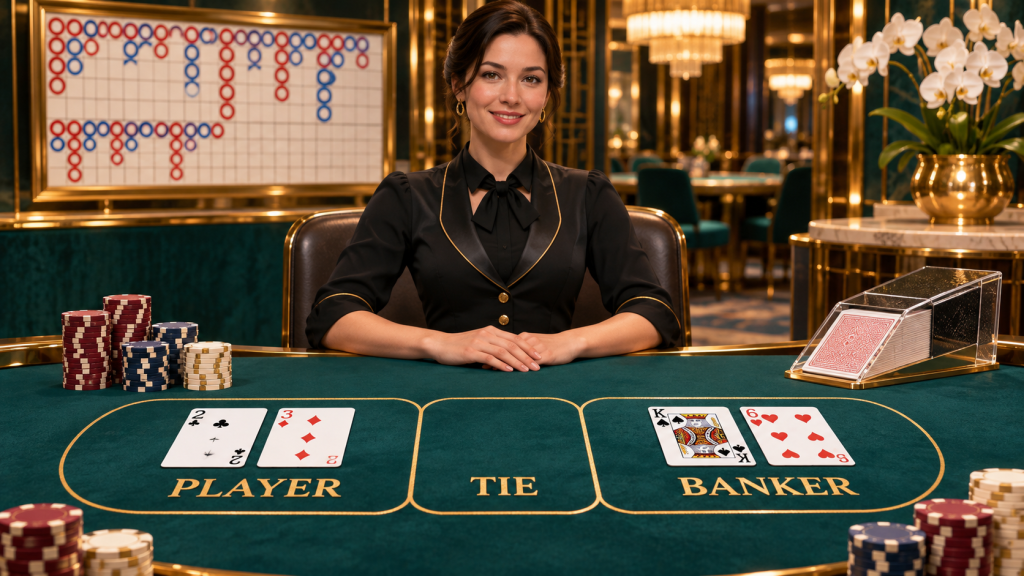
Baccarat odds describe how often an outcome occurs. House edge describes the expected cost of a wager after its payment rules are included. The numbers answer different questions, even when they appear in the same comparison table. This guide helps 188jili readers separate winning probability, payout, and theoretical return.
The Standard Eight-Deck Baseline
The figures below assume ordinary Punto Banco with eight decks, five-percent commission on winning Banker bets, and a Tie paying 8:1. Player and Banker wagers push when the hands tie.
| Wager | Round outcome probability | House edge | Theoretical RTP |
|---|---|---|---|
| Banker | About 45.86% | About 1.06% | About 98.94% |
| Player | About 44.62% | About 1.24% | About 98.76% |
| Tie at 8:1 | About 9.52% | About 14.36% | About 85.64% |
The outcome percentages include ties in the total number of rounds. That is why Banker and Player each have a winning probability below fifty percent. A Tie is a third possible result, and it normally returns the main-bet stakes.
Why Winning Probability Is Not the Whole Comparison
Banker wins more often than Player under this standard drawing schedule. However, the commission reduces the profit on each winning Banker wager. To calculate house edge, both the frequency of outcomes and the size of settlements must be included.
Tie pays considerably more per successful wager, but that larger payment comes with a much less frequent winning event. A high printed payout is therefore not the same as a high expected return.
For 188jili readers, a useful table must state its assumptions. Changing the commission, Tie payment, deck count, or exceptional settlement can change the answer.
How Theoretical RTP Is Calculated
Theoretical return to player is one hundred percent minus house edge when both use the same stake basis. A wager with a house edge of 1.06% has a theoretical RTP of approximately 98.94%.
This is a long-run mathematical average, not the percentage a person must receive in one session. A short sequence can finish above or below the theoretical figure.
| Term | What it measures | What it does not establish |
|---|---|---|
| Winning probability | Frequency of a winning outcome | Amount of profit per win |
| Payout | Profit paid for a successful wager | Frequency of success |
| House edge | Expected casino advantage per unit wagered | A fixed loss in every session |
| RTP | Expected amount returned as a percentage | A guaranteed personal result |
An Example Using Total Amount Wagered
Suppose ₱10,000 is wagered in total on standard Banker bets across many rounds. Applying the rounded 1.06% house edge gives an expected loss of about ₱106. Applying the rounded 1.24% Player figure to the same amount gives about ₱124.
The ₱10,000 represents the sum of wagers placed, not necessarily the starting balance. Reusing returned funds across multiple rounds adds to the total amount wagered. This distinction helps 188jili readers interpret an expected-cost example correctly.
Tie Payments Need Their Own Assumption
An 8:1 Tie and a 9:1 Tie are different wagers mathematically, even when the underlying event has the same probability. At 9:1 in the standard eight-deck game, the house edge is approximately 4.84%, rather than the 14.36% shown for 8:1.
Neither figure should be copied onto an unfamiliar paytable. The correct comparison follows the actual rule configuration.
Do Recent Results Predict the Next Winner?
A record of Banker and Player results describes completed rounds. It does not make a switch or continuation certain. In a finite shoe, remaining card composition can affect exact probabilities, but a visible streak alone does not provide a dependable prediction.
The baseline percentages remain useful for explaining the game’s general structure, provided they are not presented as a promise about the next hand.
Baccarat Probability FAQ
Why is Banker’s win probability below fifty percent?
Because the quoted round probabilities include Tie outcomes. Some rounds produce neither a Banker win nor a Player win.
Does a lower house edge guarantee a winning session?
No. It describes expected return across repeated play under the stated rules.
Which figures should be compared together?
Compare probability, payout, and house edge using the same deck count and settlement assumptions. This gives 188jili readers a consistent basis for understanding baccarat mathematics.