
How often do all seven cards available to one player produce a flush, a full house or a straight? This 188jili guide answers using every possible seven-card combination, with each set classified by its best five-card hand.
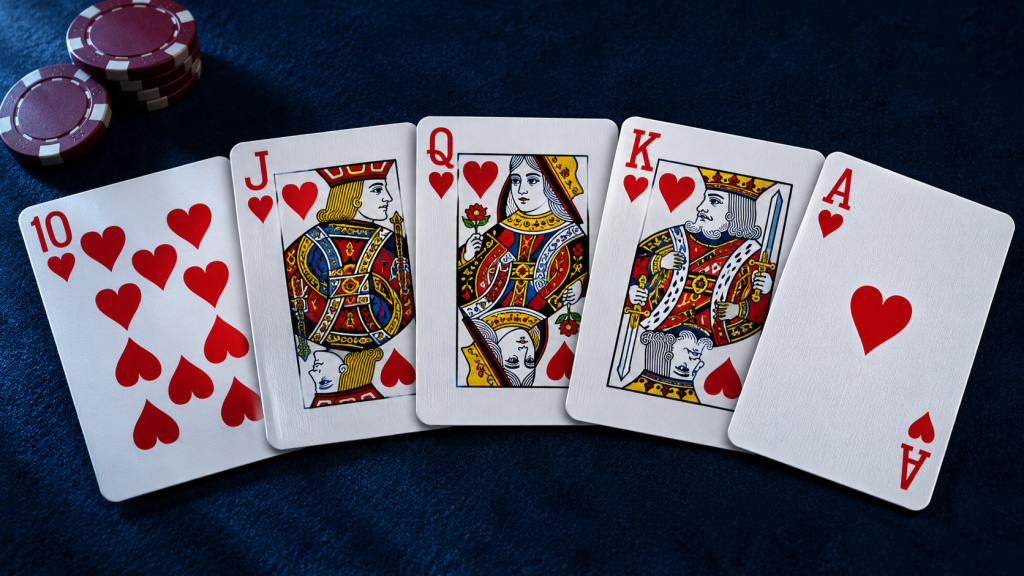
How Often Each Hold’em Hand Appears
A player with two hole cards and a complete five-card board has seven cards to work with. There are 133,784,560 ways to choose seven distinct cards from 52. The percentages cover a random player hand plus a fully dealt board, with no filtering by who stayed in until the river.
| Best five-card hand | Seven-card combinations | Probability |
|---|---|---|
| Royal flush | 4,324 | 0.0032% |
| Other straight flush | 37,260 | 0.0279% |
| Four of a kind | 224,848 | 0.1681% |
| Full house | 3,473,184 | 2.5961% |
| Flush | 4,047,644 | 3.0255% |
| Straight | 6,180,020 | 4.6194% |
| Three of a kind | 6,461,620 | 4.8299% |
| Two pair | 31,433,400 | 23.4955% |
| One pair | 58,627,800 | 43.8225% |
| High card | 23,294,460 | 17.4119% |
Why the Categories Add Up
Each combination belongs to a single row. If seven cards contain three kings and two sixes, their full house takes precedence over the three-of-a-kind and pair possibilities. The 188jili chart lists the royal flush separately within the straight-flush family, so the second row covers all other straight flushes.
How to Count Quads and Royal Flushes
| Hand | Counting method |
|---|---|
| Four of a kind | Choose one of 13 ranks for all four cards, and choose any three of the other 48 cards |
| Royal flush | Choose one of four suits for the five royal cards, and choose any two of the other 47 cards |
This gives 13 × C(48, 3) = 224,848 sets with quads and 4 × C(47, 2) = 4,324 with a royal flush. Seven cards cannot hold two different quads or two royals, so these counts have no duplicate cases. There also aren’t enough cards to hold quads and a straight flush together. In this 188jili example, that makes these two categories good places to start when learning combinations.
How to Use the Odds Once You See a Flop
The overall full-house frequency is about 2.60%, while your chance from a particular board depends on what is already visible. For example, pocket eights on an A-7-2 flop have a 2.50% chance to make a full house by the river. There are 27 qualifying turn-and-river pairs among 1,081 possible pairs, combining the eight-plus-board-pair cases with the cases where both new cards match one of the flop ranks.
Use the 188jili frequency chart to compare completed hand types across a full deal. Once you know your hole cards and see the board, recalculate using those cards to answer the specific question in front of you.